How Stablecoins Transform Payment Infrastructure

The discussion on stablecoins has evolved, highlighting their role not as deposit competitors but as essential components of market infrastructure. Moody’s 2026 outlook forecasts significant increases in stablecoin transaction volume driven by institutional use. This suggests stablecoins enhance liquidity dynamics rather than displacing traditional deposits, leading to a hybrid financial landscape. … More How Stablecoins Transform Payment Infrastructure

Stablecoins and Deposit Substitution: Key Insights for Financial Stability

The dialogue on stablecoins and deposit substitution is evolving, highlighting their modest impact on U.S. bank deposits. Currently at about 1.5% of deposits, stablecoins influence the banking landscape through direct substitution, recycling, and restructuring. While not an immediate threat, their growth could affect deposit stability and liquidity, prompting shifts in funding dynamics. … More Stablecoins and Deposit Substitution: Key Insights for Financial Stability

Year-End Funding Insights: Market Plumbing Matters

In Q3 2025, domestic deposits rose for the fifth consecutive quarter, driven by uninsured balances. Money market funds reached $7.73 trillion, indicating ongoing shifts in funding preferences. Meanwhile, the Federal Reserve is exploring stablecoins’ potential, highlighting a trend that integrates liquidity operations and digital finance strategies into future discussions. … More Year-End Funding Insights: Market Plumbing Matters

SRF & Repo Markets: What Late-2025 Taught Us About Liquidity Backstops

The Federal Reserve’s Standing Repo Facility (SRF) has evolved to operate without an aggregate cap, allowing for unlimited liquidity based on eligibility and collateral. Usage increased significantly in late-2025, primarily under stress conditions, yet the SRF remains a backstop for funding, emphasizing the importance of collateral management in liquidity strategies. … More SRF & Repo Markets: What Late-2025 Taught Us About Liquidity Backstops

Liquidity, Market Functioning, and Policy Signals — A Notable Week for Funding Markets

This week, the Federal Reserve announced $40 billion in Treasury bill purchases to enhance liquidity and relieve pressure in short-term funding markets, while framing it as a technical measure. Concurrently, the Fed cut its policy rate by 25 bps to 3.5–3.75%, emphasizing the importance of market functioning as year-end approaches. … More Liquidity, Market Functioning, and Policy Signals — A Notable Week for Funding Markets

The Consumer Credit Picture Is Getting Harder to See

The health of U.S. consumers is increasingly complex due to the rise of private credit, which is set to grow to nearly $140 billion in lending. This shift complicates traditional assessments, as banks focus on higher-credit borrowers, causing fragmentation and uncertainty in consumer spending patterns and credit availability. … More The Consumer Credit Picture Is Getting Harder to See

Liquidity, Deposits & the Rise of Digital-Native Banking — What December 2025 Is Showing Us

Investors added about US$105 billion to U.S. money-market funds recently, indicating a preference for safe assets ahead of the Fed’s decisions. Bank deposits remain strong at approximately US$18.53 trillion. The emergence of stablecoins and new blockchain-based banking models signifies a shift in liquidity and funding dynamics leading up to 2026. … More Liquidity, Deposits & the Rise of Digital-Native Banking — What December 2025 Is Showing Us

Loan Yields Push Margins to New Highs — Even as Funding Headwinds Persist

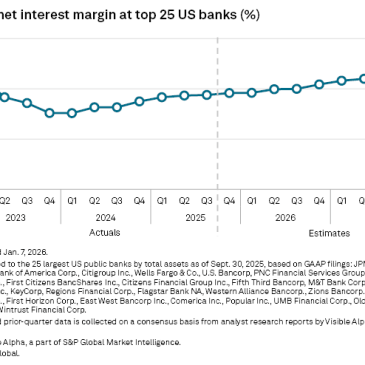
In the third quarter, the banking sector experienced improved net interest margins, the highest since 2019. Asset repricing, stable credit spreads, and a shift in asset mixes contributed to this. Deposit costs showed signs of stabilization, with increased deposit fees noted. Future margins will depend on policy easing and market dynamics. … More Loan Yields Push Margins to New Highs — Even as Funding Headwinds Persist