A. Executive summary
Entering 2026, global banking and capital markets are transitioning from the post-pandemic rate-shock period into a phase where dispersion and market “plumbing” may matter as much as headline macro variables. The observations below summarize conditions and transmission channels that appear most relevant today; they are intended as neutral framing rather than forecasts.
- Global growth is stable but not accelerating, reinforcing a “carry over expansion” dynamic rather than a new cycle. IMF projections of ~3.2% global growth in 2025 and ~3.1% in 2026 suggest the global economy is expanding near subdued post-GFC trend rates rather than entering a synchronized upswing. Implication: In such environments, financial performance is less volume-driven and more sensitive to margin structure, funding mix, and balance sheet efficiency. Dispersion across regions matters more than headline global growth.
- The policy regime has shifted from restrictive recalibration to normalization risk management. Several major central banks have moved policy rates off peak levels; in the United States, the Federal Reserve lowered the target range to 3.50%–3.75% in December 2025. Implication: The dominant risk is no longer abrupt tightening but the interaction between disinflation progress and easing pace. The slope and stability of the curve now influence bank earnings, refinancing conditions, and duration risk more than the absolute level of rates alone.
- Bank profitability remains rate-supported, but the asymmetry of funding repricing is more visible. Net interest income continues to anchor earnings; however, deposit betas and wholesale funding costs have repriced faster and more heterogeneously than in prior cycles. Implication: The marginal earnings benefit of rates is no longer uniform across institutions. Franchise composition—deposit mix, uninsured balances, and wholesale reliance—has become a more defining differentiator than policy level itself.
- Asset quality appears resilient at the aggregate level, but risk is increasingly distributional rather than systemic. Broad credit metrics remain stable, yet concentrated watch areas persist in commercial real estate segments, unsecured consumer normalization, and leveraged refinancing cohorts facing higher cost of capital. Implication: The next phase of the credit cycle is likely to be characterized by dispersion—where outcomes are driven by asset class, vintage, and structure—rather than uniform deterioration.
- Liquidity conditions are shaped as much by market infrastructure as by monetary policy. Collateral mobility, central clearing, intraday liquidity management, and reserve distribution increasingly influence funding stability. The evolution of standing repo operations and discount window readiness reflects a post-2020 framework in which backstops are structurally embedded. Implication: Liquidity risk is less about absolute reserve levels and more about how quickly collateral can be mobilized and funding accessed under time compression.
- Non-bank financial intermediation is now a structural feature of global finance, not a peripheral one. With NBFI assets reaching $256.8 trillion in 2024 (51% of global financial assets), credit creation and liquidity transformation increasingly occur outside traditional bank balance sheets. Implication: Banking system risk may emerge through interconnected exposures—fund financing, derivatives, syndications—rather than direct loan book deterioration alone.
- Payments modernization is evolving into balance-sheet modernization. Stablecoins and tokenization intersect with deposits, Treasury bills, and repo markets. BIS research indicates stablecoin flows can measurably influence short-term safe-asset pricing. Implication: The significance lies not in current scale, but in reduced friction. As liquidity pathways become faster and more programmable, the speed of funding reallocation becomes a more material variable than the size of digital instruments.
- Capital markets are functioning, but capacity remains conditional. U.S. corporate bond issuance (~$239.4B in January 2026) and elevated trading volumes indicate active markets. Implication: Market depth remains sensitive to volatility regimes and balance-sheet constraints. Functioning issuance does not eliminate episodic liquidity strain during collateral scarcity or volatility spikes.
Areas to watch
- Inflation convergence vs. policy calibration. The key uncertainty is not direction, but pace: whether inflation converges smoothly to target without inducing growth deceleration, and how central banks adjust easing trajectories in response. Structural question: Does easing stabilize margins, or compress them faster through deposit repricing and curve flattening?
- Credit dispersion versus systemic stress. Aggregate asset quality metrics may obscure pockets of vulnerability—particularly in CRE sub-segments and leveraged refinancing cohorts. Structural question: Does dispersion remain idiosyncratic, or does funding stress create correlation across sectors?
- Liquidity distribution and facility behavior. Operational changes to standing repo operations and discount window collateral frameworks alter the architecture of contingent liquidity. Structural question: Do these facilities reduce secured funding tail risk, or simply redefine where and when stress appears?
- Stablecoin perimeter and reserve composition. Regulatory evolution and reserve allocation choices (deposits vs. T-bills/repo) will determine whether stablecoins act primarily as deposit substitutes or as short-term sovereign demand amplifiers. Structural question: Does digital liquidity increase funding concentration or redistribute it?
- NBFI cycle sensitivity and transmission channels. The resilience of private credit and broader NBFI structures in a slowdown remains uncertain. Structural question: If stress emerges, does it transmit via margin, redemption, and warehousing channels back to bank balance sheets?
- Fragmentation and cross-border funding friction. Geopolitical developments and regulatory divergence may influence collateral eligibility, funding costs, and operational liquidity mobility. Structural question: Does fragmentation gradually increase structural funding premia, even absent acute crisis?
B. Macro and financial conditions backdrop
B.1 Growth, inflation, and macro cross-currents
Entering 2026, the macro environment is less about directional shock and more about distribution and durability. Inflation has moderated materially from post-pandemic peaks, and policy settings in several advanced economies are shifting from overtly restrictive toward calibration. Growth remains positive, but the defining feature is not expansion; it is dispersion.
Global growth projections near ~3.1%–3.2% imply the world economy is operating close to a subdued post-2000 trend rather than entering a synchronized recovery phase. The implication is that financial sector performance may be driven less by cyclical acceleration and more by relative positioning, balance sheet structure, and cross-regional divergence.
Structural Cross-Currents
- Disinflation vs. Re-acceleration Risk: Inflation has eased, but convergence is uneven across components and jurisdictions. Goods disinflation has progressed faster than services disinflation in many advanced economies. The key macro risk entering 2026 is not a re-run of the 2022 inflation shock, but the possibility that services inflation or wage persistence slows convergence to target. Implication: If services inflation proves sticky, policy easing may slow or pause. For banks, that affects curve shape, duration risk, deposit repricing dynamics, and refinancing windows in capital markets. The relevant question for 2026 is not “are rates high?” but “how stable is the disinflation trajectory?”
- Labor market rebalancing: Labor markets are gradually cooling from historically tight conditions. This rebalancing supports disinflation but introduces asymmetrical credit risk. A modest softening can normalize wage growth without materially affecting household solvency; a sharper adjustment can expose highly leveraged or income-sensitive borrower cohorts. Implication: Consumer credit risk entering 2026 may be nonlinear. Early-stage delinquency normalization may not signal systemic weakness—but dispersion by income bracket, geography, and product type may matter more than aggregate metrics.
- Fiscal-financial interactions: Sovereign issuance remains elevated in several advanced economies. High supply intersects with dealer balance sheet capacity, repo market depth, and term premium dynamics. In a rate-normalization phase, the interaction between sovereign supply and private demand becomes more visible. Unlike in the quantitative easing era, absorption capacity cannot be assumed to be balance-sheet agnostic. Implication: Term premium and curve volatility may reflect supply-demand imbalances as much as inflation expectations. This has second-order consequences for mortgage rates, duration hedging activity, and fixed income issuance timing.
- China and Emerging Markets Spillover: China’s growth profile and policy stance continue to influence commodity channels, regional trade partners, and risk appetite across emerging markets. In a moderate global expansion, emerging market dispersion can widen quickly depending on dollar funding conditions, commodity price stability, and domestic inflation credibility. Implication: Cross-border funding conditions and FX liquidity may become more sensitive to episodic shifts in risk sentiment than to underlying growth trends alone.
B.2 Rates, curves, liquidity conditions, and risk appetite
Financial conditions entering 2026 reflect a transition from rate shock to rate management. The acute adjustment phase of 2022–2023 repriced risk across asset classes. The current phase is characterized by front-end rate recalibration, curve re-steepening or re-flattening debates, and uncertainty around the terminal policy path.
The December 2025 rate adjustment in the U.S. underscores this shift: the debate is no longer about containing runaway inflation, but about calibrating policy without destabilizing financial conditions.
High-level indicators to watch:
- Rates and curves: The slope and stability of yield curves are now more informative than the absolute level of policy rates. A steepening curve supports bank asset-liability transformation. A flattening curve compresses marginal NIM expansion. Real rate levels influence corporate refinancing appetite and investment hurdle rates. Implication: Banks and capital markets participants are increasingly sensitive to curve volatility rather than to incremental policy moves. The dispersion of earnings and issuance windows may be driven by curve dynamics rather than rate levels.
- Liquidity: Liquidity conditions are increasingly shaped by collateral supply, repo market functioning, central clearing margin flows, and reserve distribution. This reflects a structural shift: in modern financial systems, liquidity stress often emerges through plumbing rather than through headline rate moves. Reporting dates (quarter-end, year-end), regulatory windows, and balance sheet optimization cycles can create episodic tightness even in otherwise benign macro conditions. Implication: Liquidity risk in 2026 may manifest as short-duration funding volatility or collateral scarcity rather than broad-based funding withdrawal.
- Credit spreads: Credit spreads entering 2026 are influenced by macro stability, refinancing pipelines, and investor risk tolerance. Spread compression or widening does not simply reflect credit quality; it reflects the market’s willingness to warehouse duration and credit risk in a moderate-growth environment. Implication: For banks, spread dynamics influence: underwriting pipelines, syndication execution, and held-for-investment valuation marks. For issuers, spread volatility can change refinancing timing more quickly than macro growth projections.
- Volatility and positioning: Cross-asset volatility—rates, FX, equities—has a direct mechanical effect on margin requirements, collateral calls, dealer balance sheet usage. In a system with large centrally cleared exposures and significant derivative notional, volatility is not only a pricing variable; it is a liquidity variable. Implication: Even absent macro deterioration, volatility spikes can increase liquidity demand through margining channels, tightening funding conditions temporarily and amplifying market moves.
C. Global Banking: state of play entering 2026
C.1 Profitability mix: net interest income, fees, and cost base
Profitability entering 2026 is not simply “rate supported.” It is composition sensitive. The post-2022 tightening cycle produced a classic first-phase dynamic: asset yields repriced faster than deposits, widening margins. The later phase of the cycle has exposed the asymmetry embedded in deposit repricing. Deposit betas have risen more rapidly than in prior cycles, particularly where funding bases are more transactional than relationship-driven, uninsured balances are material, and customers have seamless access to money market alternatives. The result is not uniform margin compression but widening dispersion across institutions.
The earnings conversation is shifting from “rate level” to “funding elasticity.” Institutions with stable deposit franchises and diversified fee income are experiencing a different margin trajectory than those reliant on rate-sensitive funding or wholesale markets.
At the same time, noninterest income is reasserting its cyclical role. Capital markets activity—underwriting, advisory, trading—has improved relative to the peak volatility period, but fee income remains correlated to issuance windows and risk appetite rather than to macro growth alone. Operating expense dynamics add a third layer, i.e., technology and data investment, operational resilience and cybersecurity, governance and compliance costs.
Supervisory emphasis on governance and risk management in material risk areas further embeds cost discipline as a structural rather than cyclical variable. Implication: The 2026 profitability profile is defined less by margin expansion than by earnings stability and funding resilience. Earnings dispersion may widen based on funding mix, fee cyclicality, and cost-to-income operating leverage.
C.2 Credit and asset quality: broad trends and concentrated watch areas
Aggregate asset quality metrics across major jurisdictions remain stable entering 2026. However, this stability masks a structural shift from system-wide credit cycles to asset-class-specific repricing cycles.
The risk environment is increasingly distributional:
- Commercial Real Estate (CRE): In many markets, CRE stress is not defined by near-term delinquency spikes, but by: refinancing at materially higher rates, uncertain valuation floors, and reduced transaction liquidity. This creates what can be described as “time-to-refinance risk.” Assets that appear current may face stress at maturity rather than through early delinquency signals. Implication: The credit cycle is migrating from flow risk (new originations) to stock risk (existing portfolios refinancing under new rate regimes).
- Consumer Credit Normalization: Consumer credit performance reflects normalization from exceptionally benign pandemic-era conditions. Even modest labor market softening can produce visible increases in delinquencies in unsecured portfolios. However, aggregate normalization does not automatically imply systemic deterioration. Implication: Consumer credit risk entering 2026 may show dispersion by borrower income cohort, product type (credit card vs. auto vs. personal loans), and underwriting vintage.
- Leveraged and Private Credit Linkages: Direct exposure to highly leveraged borrowers may be contained in some banking systems, but second-order exposures remain meaningful through syndications, warehousing facilities, fund financing, and derivative counterparty risk. With non-bank financial intermediation representing over half of global financial assets, the question is not whether banks hold the loans directly, but whether they are structurally connected to vehicles that do. Implication: Credit stress in 2026, if it emerges, may transmit through financing channels and market liquidity before it appears in traditional NPL ratios.
C.3 Capital and liquidity position: buffers and liquidity composition
Capital and liquidity entering 2026 reflect both regulatory reforms and lived stress experience (notably 2023).
- Capital Buffers: Headline CET1 ratios remain broadly stable in many jurisdictions. However, internal capital generation is sensitive to provisioning trends, risk-weighted asset inflation from mix changes, and earnings dispersion. Capital strength at the system level does not eliminate firm-level heterogeneity. Structural interpretation: Capital resilience in 2026 is less about adequacy and more about flexibility, the ability to absorb volatility while maintaining market confidence and funding stability.
- Liquidity Composition: Liquidity quality matters as much as quantity. The mix between reserves and cash, high-quality liquid securities, and secured funding capacity determines how quickly institutions can respond to funding stress. Liquidity episodes since 2023 reinforced that runoff assumptions can compress rapidly, speed matters more than absolute buffer size, and collateral mobility is critical.
- Contingent Liquidity Readiness: Operational readiness for contingent liquidity (e.g., Discount Window pre-positioning and collateralization) has increased materially in recent years. The structural shift is not that facilities exist — they always have — but that operational readiness is more widespread. Implication: Liquidity backstops are now embedded in stress scenario architecture. However, stigma, operational frictions, and timing considerations still influence real-world behavior. Liquidity risk in 2026 is therefore less about solvency buffers and more about execution speed and collateral transformation capacity.
C.4 Funding mix: deposits vs. wholesale, and where sensitivity is showing up
Funding remains the defining variable entering 2026. The 2022–2024 period demonstrated that deposit stickiness is not monolithic. It varies across segments, retail insured vs. corporate treasuries, operational vs. rate-sensitive balances, and relationship-driven vs. platform-driven deposits.
Money market fund assets (~$7.8 trillion by Q3 2025) underscore the scale of rate-sensitive alternatives. This is not a marginal competitor; it is a parallel liquidity system. Structural interpretation: The relevant risk is not aggregate deposit decline, but funding elasticity.
Where sensitivity appears first:
- Rate-Sensitive Corporate and Uninsured Deposits: Balances managed by professional treasurers are responsive to yield differentials, counterparty risk perception, and operational convenience. This creates a funding layer that can reprice quickly when spreads widen.
- Secured Wholesale Funding: Repo and secured funding markets are sensitive to collateral scarcity (quarter-/year-end), margin adjustments, and volatility-induced balance sheet usage. Funding cost volatility may appear episodically rather than trend-like.
- Concentration Effects: Even if system-level deposits remain stable, composition can shift toward fewer large accounts, more operational deposits, or reserve deposits linked to stablecoin issuers. [JK1] [JK2] [AP3] Concentration can increase runoff volatility even when aggregate balances appear unchanged.
Exhibit C-1. U.S. money market fund assets (selected quarters)
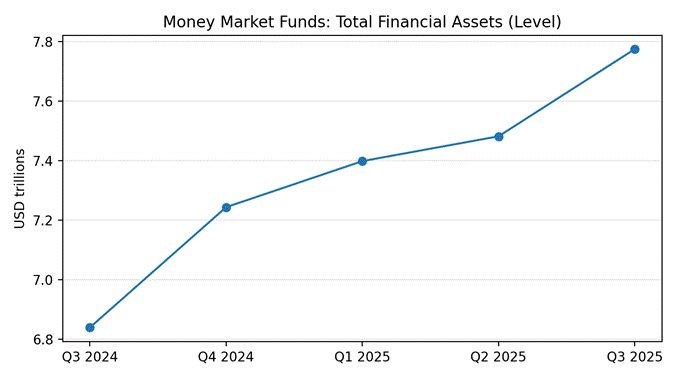
Source: Board of Governors of the Federal Reserve System (US), Z.1 Financial Accounts; series MMMFFAQ027S via FRED (last updated Jan 9, 2026).
D. Global Capital Markets: state of play entering 2026
D.1 Rates and fixed income: issuance, spreads, and refinancing/terming
Fixed income markets entering 2026 are no longer dominated by the abrupt repricing of policy expectations. Instead, they are defined by capacity, term structure stability, and refinancing distribution. The improvement in issuance volumes and trading activity—e.g., ~$239.4B in U.S. corporate issuance through January 2026 and elevated secondary trading volumes—signals that markets are functioning. But functioning markets should not be confused with frictionless markets.
The defining characteristics of 2026 fixed income conditions are:
- Refinancing Distribution, Not Volume Alone: The maturity wall is uneven. Issuers that extended duration during low-rate periods face limited near-term pressure. Those that deferred refinancing into higher-rate environments remain sensitive to spread widening and curve volatility. Implication: The refinancing cycle is not systemic—it is cohort-specific. Market stress, if it emerges, is more likely to manifest in segments that delay refinancing rather than in broad corporate default metrics.
- Spread Dispersion Reflects Risk Sorting, Not Panic: Investment-grade and high-yield spreads remain key barometers; however, widening spreads in 2026 are more likely to reflect risk repricing than liquidity collapse. The relevant variable is not average spreads, but sector-level dispersion, covenant quality, and refinancing flexibility. Implication: Spread widening is a transmission channel to bank underwriting pipelines and private credit markets. It influences capital structure decisions and may shift issuance between secured and unsecured formats.
- Sovereign Supply and Term Premium: Elevated sovereign issuance in major economies intersects with dealer balance-sheet capacity and term premium volatility. The demand-supply balance in duration is no longer neutral in a world without large-scale central bank asset purchases. Implication: Corporate spreads and issuance windows are influenced not only by credit fundamentals but by sovereign supply absorption and rate volatility.
- Collateral and Repo Conditions May Matter More Than Headline Yields: Repo market functioning and collateral haircuts affect funding costs for leveraged investors and dealers. In periods of volatility or quarter-end balance sheet constraints, repo spreads can widen even when policy rates are stable. Implication: The stability of fixed income markets in 2026 depends as much on secured funding elasticity as on corporate fundamentals.
D.2 Equities: primary issuance environment and secondary liquidity
Equity markets entering 2026 are supported by greater rate visibility relative to the peak tightening period but remain sensitive to valuation concentration and earnings dispersion.
The key structural dynamics are:
- Valuation Sensitivity to Real Rates: Equity valuations remain sensitive to real rate expectations. Even modest changes in real yields can disproportionately affect long-duration equity segments. Implication: Equity market resilience is more closely tied to rate volatility than to absolute growth rates.
- Primary Issuance is Volatility-Contingent: IPO and follow-on activity tend to reopen quickly when volatility falls, but can retrench abruptly when volatility spikes. Implication: Primary markets are a function of volatility, not a function of growth. Windows may be episodic rather than persistent.
- Secondary Liquidity and Market Depth: Secondary market liquidity—trading values, bid-ask spreads, and turnover—often appears robust in stable conditions. However, liquidity depth is not linear. It can thin rapidly when volatility rises. Implication: Market depth entering 2026 is structurally dependent on dealer balance sheet usage and passive flow dynamics. Concentration in index leadership may amplify intraday volatility during rebalancing or macro shocks.
- Cross-Asset Capital Structure Substitution: Corporates continue to assess debt vs equity financing decisions based on credit spreads, equity valuations, and rate stability. Implication: Capital structure optimization in 2026 is highly sensitive to cross-asset relative pricing. A shift in spreads can quickly redirect issuance from debt to equity or vice versa.
D.3 Market structure: clearing, collateral plumbing, and operational infrastructure
Market structure has become a first-order determinant of resilience. The scale of derivatives markets—$846T notional and $21.8T gross market value—means that margining and collateral flows are systemically relevant channels of liquidity.
- Margin Procyclicality: Margin models respond mechanically to volatility and correlation shifts. During volatility spikes, initial margin increases, variation margin flows accelerate, and liquidity demand rises even without new issuance. Implication: Liquidity stress can emerge through collateral calls rather than through credit deterioration. This is a structural feature of centrally cleared markets.
- Intraday Liquidity and Settlement Velocity: Shorter settlement cycles and greater central clearing concentration increase the importance of intraday liquidity management. Implication: Operational liquidity is now intertwined with market volatility. Infrastructure outages or settlement disruptions can translate into liquidity events even when asset prices are stable.
- Collateral Heterogeneity: Collateral is not homogeneous. Eligibility rules, haircut schedules, and CCP margin requirements differ across venues. Implication: Collateral transformation demand can widen secured funding spreads and influence repo rates independently of macro fundamentals.
D.4 Cross-asset volatility and liquidity markers
Volatility in 2026 functions as a liquidity amplifier. Rate volatility affects mortgage convexity hedging, swap spreads, and corporate duration risk. Credit volatility influences underwriting appetite, warehouse risk, and risk transfer pricing. Equity and FX volatility affect margin flows, cross-border capital allocation, and derivative positioning. The key insight is that volatility does not merely signal risk—it mechanically generates liquidity demand through margin and collateral requirements. Implication: Even in a moderate-growth macro environment, volatility regimes can create episodic liquidity strain without systemic solvency stress.
E. Structural themes shaping Banking and Capital Markets
Structural themes in 2026 are less about new products and more about how financial intermediation is reorganizing under changing constraints. The following themes are not tactical developments; they are medium-term forces reshaping liquidity, funding, collateral, and risk transmission.
E.1 Payments modernization: stablecoins, tokenization, and bank vs. nonbank competition for transactional liquidity
Payments modernization has moved beyond faster settlement rails. It is now a question of who intermediates transactional liquidity and how quickly that liquidity can reallocate across balance sheets. Stablecoins function economically as digital cash equivalents, short-duration safe asset demand vehicles, and programmable transactional instruments.
Tokenization extends this into the settlement layer of deposits, securities, and collateral, potentially reducing friction and settlement latency. The relevant shift is not technological novelty. It is the reduction of friction in liquidity movement.
What we observe
- Stablecoin reserves are predominantly invested in cash-like assets—Treasury bills, repo, money market funds, and deposits. Implication: stablecoins are embedded within the short-end sovereign and secured funding complex, not outside it.
- Various research indicates stablecoin inflows can move short-term Treasury yields by measurable basis points, particularly in shallow market conditions. Implication: stablecoins are now a marginal pricing force in the bill market. Their influence is nonlinear—more pronounced in stress or low-liquidity states.
- Stablecoin supply (~$200B) remains small relative to global deposits but significant relative to marginal bill supply. Implication: impact is flow-driven, not stock-driven. Rapid growth or redemption cycles matter more than aggregate size.
- Money market funds (~$7.8T) remain a far larger liquidity alternative. Implication: stablecoins should be analyzed within the broader ecosystem of rate-sensitive liquidity, not in isolation.
Interaction model
Liquidity now flows among three principal nodes:
- Bank deposits
- Money market / Treasury bill complex
- Stablecoin issuers
The system behaves differently depending on reserve placement:
- If reserves remain within bank deposits, stablecoin growth changes composition more than funding levels.
- If reserves migrate toward T-bills/repo, stablecoin growth shifts funding from banks to sovereign markets.
Redemption cycles reverse this flow.
Key structural insight: Stablecoins tighten the coupling between deposit behavior and short-end Treasury pricing. This increases the speed of liquidity transmission across banking and capital markets.
Banking implications
- Deposit mix and beta: stablecoins can be another competitor for rate-sensitive balances, potentially increasing repricing pressure where customers have easy switching options.
- Liquidity risk speed: tokenized/always-on instruments can compress decision and execution timelines, increasing the value of intraday visibility and operational readiness (without implying a specific action).
- Balance sheet composition: where stablecoins are backed by bank deposits (directly or via custodial arrangements), deposits may become more concentrated and operational in nature, potentially changing runoff characteristics.
Capital markets implications
- Short-end Treasury demand: stablecoin reserve allocation can influence Treasury bill demand and repo usage; research suggests measurable price effects in certain states.
- Collateral velocity and tokenized settlement: tokenization can reduce settlement frictions and trapped collateral in some designs, but it can also increase the speed at which collateral needs arise (e.g., margin calls).
- New issuance and market access: stablecoin and tokenization ecosystems may expand demand for short-term government securities and high-quality liquid assets, potentially changing relative pricing at the margin.
Watch items
- Regulatory perimeter: how stablecoin reserve requirements, issuer supervision, and redemption/liquidity requirements evolve across the U.S., UK, and EU.
- Access channels: whether and how stablecoin issuers or related intermediaries gain access (direct or indirect) to central-bank facilities or insured deposit structures (policy-dependent).
- Market structure: whether growth concentrates in a few large issuers and custodians, and how operational outages/cyber events would transmit.
Exhibit E1. Selected stablecoin reserve composition (illustrative; as disclosed by issuers)
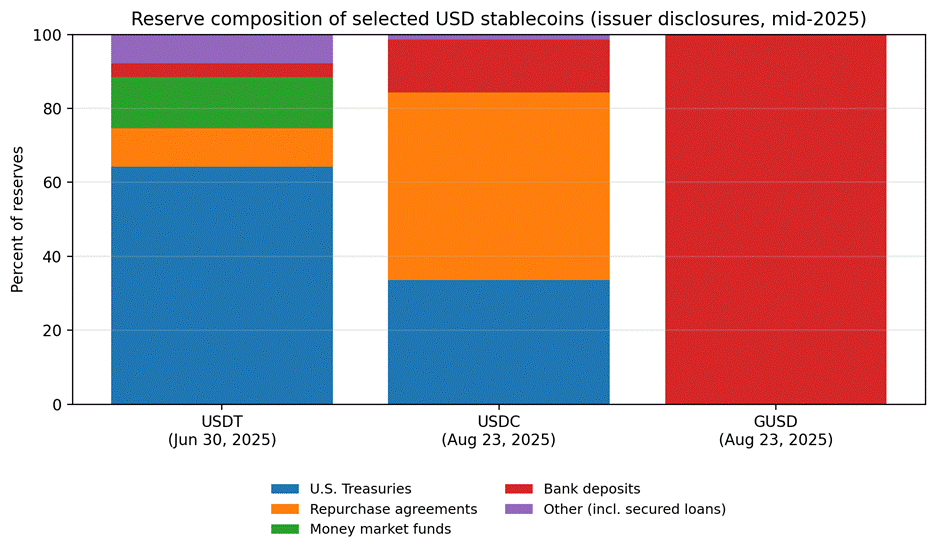
Source: Federal Reserve Board, FEDS Notes ‘Banks in the age of stablecoins’ (accessible data; reserve composition examples reported by issuers).
E.2 Liquidity backstops: SRF operations, Discount Window collateralization, and supervisory posture
Liquidity backstops have transitioned from crisis tools to structural components of monetary implementation. Standing repo operations now operate under full allotment conditions, and Discount Window collateral frameworks have been updated. Supervisory operating principles emphasize timely, material risk engagement. These developments alter the architecture of contingent liquidity—not its existence, but its perceived elasticity.
What we observe
- Standing overnight repo operations: the New York Fed’s operating policy statement notes that, effective December 11, 2025, the aggregate operational limit for standing overnight repo operations is no longer in effect, and operations will be conducted in a full-allotment format.
- SRF terms: the New York Fed’s FAQs describe two standing overnight repo operations per business day and note a per-counterparty proposition limit (e.g., $40B per eligible security type per operation), with eligible collateral including U.S. Treasury, agency debt, and agency MBS, subject to margins in the repo collateral schedule.
- Discount Window collateralization: Discount Window readiness statistics show broad participation and sizable pledged collateral. The Fed reports that the lendable value of collateral pledged by reporting institutions increased from $1,904B (2021) to $2,060B (2022) to $2,756B (2023).
- Collateral margin updates: in 2025, the Discount Window collateral valuation and margins tables were updated, effective July 1, 2025, illustrating that collateralization terms can evolve.
- Supervisory posture: a statement of supervisory operating principles (dated Oct 29, 2025; released with a Fed press communication in Nov 2025) emphasizes a focus on material financial risks and timely, proportionate supervisory action.
Banking implications
- Contingent liquidity capacity: changes to standing repo operations (e.g., full allotment and removal of an aggregate limit) may affect how banks and dealers assess secured funding backstops in stress scenarios, subject to eligibility and operational readiness.
- Collateral strategy and pre-positioning: updated Discount Window collateral margins and the importance of operational readiness can influence how firms evaluate the effective liquidity value of different collateral pools under ILST and CFP frameworks.
- Governance and documentation: supervisory operating principles can shape expectations for the clarity of liquidity governance, escalation, and contingency processes (without implying a specific supervisory outcome).
Capital markets implications
- Repo market functioning: standing repo operations interact with broader repo market conditions and may reduce tail risks of repo rate spikes, depending on usage patterns and collateral constraints.
- Collateral and margining dynamics: Discount Window and repo margins influence how collateral is valued and mobilized during stress, indirectly affecting market liquidity in high-quality collateral assets.
Watch items
- Facility usage behavior: whether and how markets use SRF/Discount Window facilities during idiosyncratic events vs. system-wide stress, including the role of stigma and operational frictions.
- Collateral elasticity: whether collateral margin practices remain stable across volatility regimes and how collateral schedules evolve for new instruments.
- Supervisory interpretation: how supervisory operating principles translate into day-to-day examination focus areas for ILST/CFP and liquidity governance.
Exhibit E2. Discount Window collateral pledged: lendable value (all institutions)
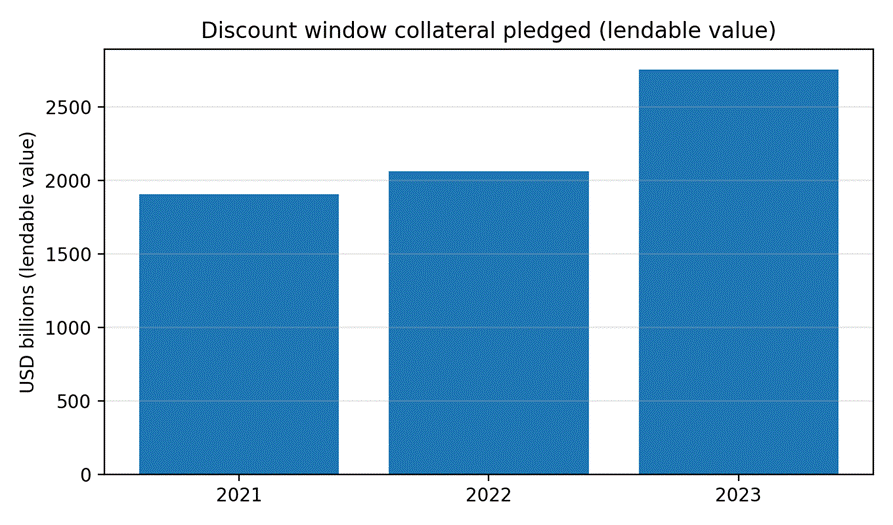
Source: Federal Reserve Board, Discount Window readiness statistics (published Apr 12, 2024; values shown for year-end collateral pledged).
E.3 Expansion of non-bank financial intermediation and private credit
NBFI represents credit and liquidity transformation occurring outside traditional bank balance sheets. With over half of global financial assets residing in NBFI structures, this is no longer a peripheral phenomenon. Private credit is one subset—direct lending outside syndicated loan markets.
What we observe
- The FSB’s 2025 monitoring report estimates that NBFI assets reached $256.8 trillion in 2024, representing 51% of global financial assets.
- The scale of NBFI implies that credit supply, liquidity transformation, and leverage can migrate across sectors rather than disappear, affecting banks through interconnected exposures (prime brokerage, derivatives, fund financing, distribution).
Exhibit E3. NBFI share of global financial assets (FSB monitoring estimate for 2024)
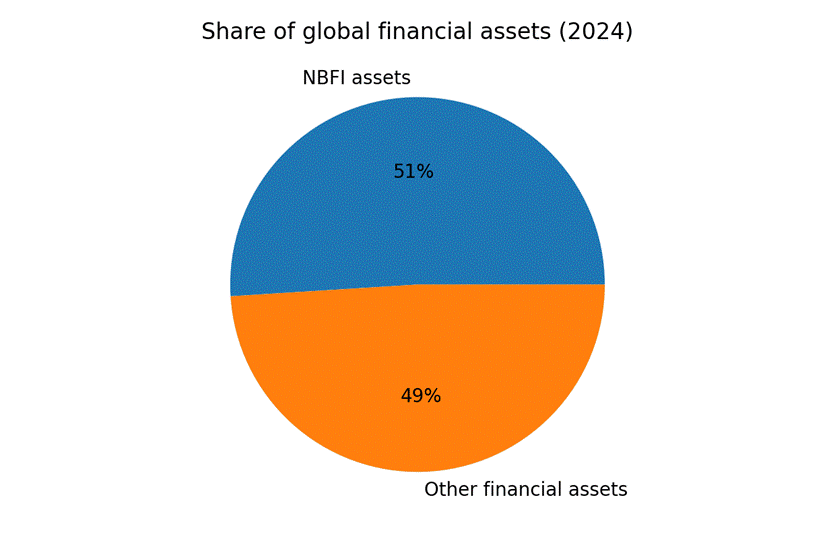
Source: Financial Stability Board, Global Monitoring Report on Non-Bank Financial Intermediation 2025 (estimate for 2024).
Banking implications
- Competition and complementarity: NBFI can both compete with banks in certain lending segments and complement them through origination, distribution, and risk transfer.
- Interconnectedness: banks can face indirect risk through fund financing, derivatives exposures, and warehousing/bridging of assets destined for NBFI balance sheets.
- Liquidity transmission: if NBFI uses leverage or offers liquidity promises, stress can transmit via margin calls, fire-sales, and withdrawals—channels that can influence bank funding markets.
Capital markets implications
- Market liquidity: NBFI activity can support market making and liquidity provision in normal times, but can amplify procyclicality during shocks through redemption and margin channels.
- Credit pricing: as credit intermediation shifts between banks and NBFI, pricing and covenant structures can evolve, influencing refinancing dynamics.
Watch items
- Loss realization timing: whether credit losses emerge with longer lags in private credit due to loan structures and valuation practices.
- Leverage and liquidity mismatch: changes in the use of leverage (repo, derivatives) by NBFI and how margin models behave in stress.
- Regulatory response: potential further alignment of bank and nonbank resilience frameworks (varies by jurisdiction).
E.4 Market structure and collateral plumbing: central clearing, margining, and collateral mobility
‘Collateral plumbing’ refers to the infrastructure and practices that determine how collateral is valued, moved, rehypothecated, and pledged across financial markets. As more activity is centrally cleared (in derivatives and potentially in cash markets), margining and settlement flows become more central to liquidity dynamics.
What we observe
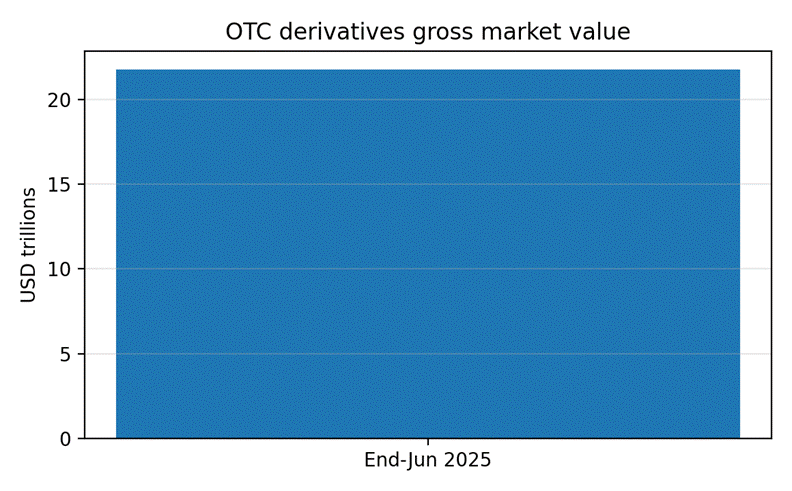
- OTC derivatives markets remain large: BIS reported $846 trillion in notional outstanding and $21.8 trillion in gross market value at end-June 2025.
- These magnitudes underscore why volatility regimes, margin models, and settlement cycles can materially change liquidity demand even without large changes in ‘real economy’ variables.
- Repo collateral schedules and Discount Window margins illustrate the operational reality that collateral is not a single homogeneous asset; eligibility and haircut/margin schedules are program-specific.
Exhibit E4. OTC derivatives gross market value (end-June 2025)
Source: BIS, OTC Derivatives Statistics at end-June 2025.
Banking implications
- Intraday liquidity: settlement and margin flows can increase the need for intraday liquidity monitoring and for reliable collateral mobilization channels, especially during volatility spikes.
- Balance sheet usage: secured funding and client clearing services consume balance sheet and can be sensitive to leverage constraints and GSIB surcharges (jurisdiction-dependent).
- Operational risk: outages or settlement delays in key FMIs can have liquidity effects even if credit fundamentals are unchanged.
Capital markets implications
- Procyclicality of margin: rising volatility can increase initial margin and variation margin flows, influencing liquidity and potentially amplifying moves in underlying markets.
- Collateral transformation demand: market participants may seek to transform lower-quality collateral into eligible forms for CCPs or repo, affecting repo spreads and secured funding conditions.
Watch items
- Clearing scope: whether clearing mandates and industry practices expand in cash markets and additional derivatives classes, changing collateral needs.
- Margin model behavior: the sensitivity of margin requirements to volatility and correlations during stress.
- Settlement modernization: how tokenized collateral and shorter settlement cycles impact liquidity demand and operational resilience (design-dependent).
E.5 Cross-border liquidity, funding, and fragmentation risk
Global banks and capital markets rely on cross-border funding, FX swap markets, correspondent banking networks, and cross-currency collateral flows. Fragmentation risk refers to the possibility that geopolitical events, sanctions regimes, or regulatory divergence reduce the substitutability of liquidity across jurisdictions, raising the cost of moving liquidity and collateral.
What we observe
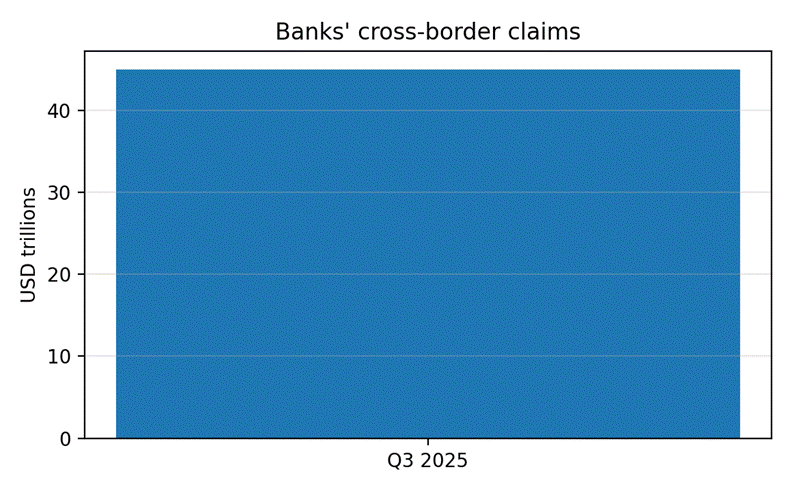
- BIS international banking statistics show that banks’ cross-border claims were about $45 trillion in Q3 2025, up about 5% year-over-year (at constant exchange rates).
- Cross-border exposures can transmit stress through funding channels (FX swaps, cross-currency basis), through subsidiaries/branches, and through collateral eligibility differences.
Exhibit E5. Cross-border bank claims (BIS, Q3 2025 level)
Source: BIS, International banking statistics (Q3 2025).
Banking implications
- Liquidity location matters: internal liquidity transfer constraints and ring-fencing considerations can become more binding under stress, affecting group-level ILST assumptions.
- FX liquidity: cross-currency funding costs can move quickly, influencing both banks’ funding costs and the hedging costs of international investors.
Capital markets implications
- Fragmented collateral pools: if collateral eligibility differs more across venues/CCPs/jurisdictions, collateral transformation demand can rise and market liquidity can become more episodic.
- Cross-border issuance and investment: shifts in cross-border investor demand can affect sovereign and corporate issuance costs and market depth.
Watch items
- Sanctions and capital controls: changes in restrictions can alter payment flows, settlement chains, and correspondent banking risk management.
- Regulatory divergence: differences in liquidity frameworks, resolution rules, and margining practices can influence cross-border intermediation capacity.
E.6 Treasury and repo market capacity: dealer balance sheets, official-sector facilities, and collateral scarcity windows
Treasury and repo market capacity refers to the ability of dealers, banks, and other intermediaries to absorb issuance, intermediate trading flows, and finance positions. In modern markets, capacity is affected by regulation (leverage constraints), risk limits, market volatility, and the design of official-sector facilities (e.g., SRF, repo operations).
What we observe
- Market participants have explicitly linked repo facility design to market functioning: in the December 2025 FOMC minutes, some participants and market contacts highlighted potential benefits of eliminating the standing repo facility’s aggregate operational limit and adjusting related parameters; subsequently, the New York Fed communicated that the aggregate operational limit is no longer in effect and operations moved to full allotment.
- Repo collateral schedules specify margins and eligible collateral types; these details shape the effective funding value of collateral during scarcity windows (quarter-/year-end).
Banking implications
- Secured funding resilience: a more elastic official backstop can change the tail distribution of secured funding rates, but practical impact depends on counterparties’ eligibility, collateral, and operational readiness.
- Liquidity stress assumptions: if repo conditions become more volatile around reporting dates, internal stress tests may show more dispersion across scenarios; a standing backstop can be one factor among many.
Capital markets implications
- Treasury market liquidity: dealer capacity and financing conditions influence bid-ask spreads and the ability to warehouse risk during high issuance periods.
- Short-end pricing: stablecoin and MMF demand for T-bills can interact with repo supply and official facility usage, affecting bill yields at the margin.
Watch items
- Structural vs. cyclical liquidity: whether periodic scarcity is driven primarily by structural balance-sheet constraints or by temporary risk-off episodes.
- Facility parameter evolution: potential future adjustments to repo operations frameworks, including collateral schedules and operational design.
E.7 AI, data, and operational resilience as financial stability variables
Technology is not new in financial services, but several 2026-relevant shifts are making it a more direct balance-sheet and market-structure variable: (i) increased AI use in decisioning and client interaction, (ii) deeper reliance on third-party and cloud infrastructure, and (iii) heightened cyber risk. Operational resilience can influence liquidity and market confidence even when solvency is strong.
What we observe
- Financial stability reports continue to emphasize that operational disruptions and cyber incidents can have system-wide implications via payment/settlement chains and through confidence effects.
- As markets move toward faster settlement and more digital collateral/plumbing, the tolerance for outages and data quality issues decreases (design-dependent).
Banking implications
- Model and conduct risk: wider AI adoption can improve efficiency but may introduce governance and explainability challenges, especially in credit and compliance.
- Operational liquidity: operational disruptions can trigger liquidity needs (e.g., settlement failures, margin disputes) and can interact with contingency funding plans.
Capital markets implications
- Execution and settlement resilience: market structure improvements can reduce risk, but tightly coupled systems can also propagate outages more quickly.
- Data and transparency: improved data can enhance liquidity and price discovery; uneven data quality can do the opposite.
Watch items
- Operational event clustering: whether the frequency/severity of cyber and operational events increases, and how quickly markets recover.
- Regulatory expectations: how operational resilience and AI governance requirements evolve across jurisdictions.
F. Regional snapshots
F.1 United States
Macro and policy context
The U.S. enters 2026 in a policy environment that has shifted from a restrictive stance to calibration. The late-2025 move toward easing reduces the probability of further broad duration repricing but increases the importance of second-order effects: curve shape, term premium, and the sensitivity of rates to fiscal supply absorption. In the U.S., the macro question is less “growth vs recession” and more “how stable are financial conditions under high sovereign supply?” The path of inflation still matters, but the mechanism of transmission increasingly runs through the Treasury and repo complex, where issuance, dealer balance sheets, and collateral dynamics can tighten financial conditions independent of policy intent.
Banking: profitability, credit, and buffers
U.S. banking conditions entering 2026 show solid aggregate profitability but with meaningful dispersion by size, business model, and balance-sheet mix. FDIC quarterly reporting for the third quarter of 2025 showed net income of $79.3B for FDIC-insured institutions and continued monitoring of credit and funding conditions. Liquidity and funding discussions remain informed by the 2023 episode and by the observable growth of cash alternatives (money market funds, short-end Treasuries).
- Funding competition: money market fund assets were ~$7.77T by Q3 2025 (Z.1/FRED), underscoring the scale of rate-sensitive cash alternatives.
- Contingent liquidity: Discount Window readiness statistics show pledged collateral lendable value of $2.756T in 2023 and broad participation among institutions.
- Backstop evolution: standing overnight repo operations moved to full allotment with the aggregate operational limit no longer in effect (effective Dec 11, 2025).
Capital markets: fixed income, equities, and market structure
U.S. capital markets conditions entering 2026 reflect improved rate clarity relative to the peak tightening phase, but continued sensitivity to risk appetite and liquidity regimes. SIFMA’s U.S. corporate bond statistics show issuance through January 2026 of $239.4B (+2.5% Y/Y) and trading ADV of $70.3B (+25% Y/Y), with outstanding corporate bonds around $11.5T through Q3 2025. Market structure themes (central clearing, collateral plumbing) are relevant due to the scale of derivatives and repo markets.
Watch items (U.S.)
- Funding elasticity: whether deposit repricing accelerates (especially in rate-sensitive corporate and uninsured segments) and whether that changes liquidity risk speed more than liquidity size.
- Treasury/repo capacity: whether scarcity windows become more frequent under issuance + balance-sheet constraints, and how facility design translates into behavior.
- Stablecoin perimeter and reserve placement: whether stablecoin growth shifts funding composition toward T-bills/repo, strengthening the link between “digital cash demand” and short-end sovereign pricing.
- Credit dispersion: whether CRE/consumer stress remains localized or becomes correlated via funding and market liquidity channels.
F.2 United Kingdom
Macro and policy context
The UK enters 2026 with a continued focus on inflation dynamics, household balance sheets, and the interaction between gilt market conditions and financial stability. The Bank of England’s Financial Stability Report (December 2025) provides an official-sector view of system vulnerabilities and resilience themes.
Banking: resilience and key themes
UK banks’ resilience is typically discussed in terms of capital and liquidity buffers, funding mix, and exposure to UK households and commercial real estate. BoE stability materials also emphasize market-based finance linkages, including pension and nonbank sector behaviors, that can transmit to bank funding markets.
Capital markets: gilt market, repo, and market-based finance
The UK’s capital markets outlook remains closely linked to gilt market functioning and to the role of nonbanks (including pensions) in leverage and liquidity dynamics. The BoE has continued to analyze vulnerabilities in market-based finance and to discuss how market structures can amplify or absorb shocks.
Watch items (UK)
- Market-based finance: leverage and liquidity mismatch dynamics in nonbank sectors and how they transmit to gilt and repo markets.
- Cross-border funding and FX liquidity: the sensitivity of cross-currency markets to global risk sentiment.
- Operational resilience: potential for operational/cyber disruptions to propagate through concentrated infrastructures.
F.3 European Union
Macro and policy context
The EU enters 2026 with a focus on growth dispersion across member states, the path of inflation convergence, and evolving regulatory and supervisory frameworks. Banking system metrics are commonly referenced through ECB supervisory banking statistics and EBA risk dashboards.
Banking: profitability, asset quality, and buffers
EU banking conditions entering 2026 reflect improved profitability versus the ultra-low-rate era, while maintaining supervisory focus on asset quality, interest rate risk management, and liquidity. The EBA risk dashboard provides standardized snapshots of solvency, asset quality, and liquidity indicators. ECB supervisory statistics provide complementary system-wide measures for significant institutions.
Capital markets: market depth and integration themes
EU capital markets themes include market depth and fragmentation, clearing and settlement infrastructure, and cross-border issuance/investment flows. Collateral and derivatives plumbing remain important due to the scale of cleared derivatives and the role of sovereign debt as collateral.
Watch items (EU)
- Sovereign-bank nexus and fragmentation: changes in spreads and collateral haircuts in stress regimes (uncertain).
- Cross-border liquidity: interaction between global USD funding conditions and EU bank funding/derivatives markets.
- NBFI growth: private credit and investment fund behavior under stress, and transmission to banks and markets.
F.4 Rest of world (APAC + select EM/MENA/LATAM)
A compact Rest-of-World view emphasizes two points: (i) macro dispersion is higher than in the U.S./UK/EU group, and (ii) global liquidity and risk appetite transmit quickly through FX markets, cross-border bank claims, and commodity channels. IMF projections provide a baseline view of global growth with regional heterogeneity. BIS international banking statistics help frame the scale of cross-border linkages.
Common cross-regional themes entering 2026:
- China and property/credit channels: effects on commodity demand, EM trade partners, and global risk appetite (scenario-dependent).
- Japan: rate and curve dynamics can affect global fixed income positioning and FX-hedged flows (sensitive to domestic policy).
- Emerging Markets funding conditions: sensitivity to USD rates, commodity prices, and local inflation credibility.
G. Data appendix
This appendix lists the primary public datasets and documents used for quantitative reference points in this draft, along with brief notes on definitions and chart provenance.
G.1 Chart provenance
Exhibit C-1: Money market fund assets (selected quarters)
- Series: MMMFFAQ027S (Money Market Funds; Total Financial Assets, Level) via FRED.
- Values used: Q3 2024–Q3 2025 as shown on the series page (USD millions).
Exhibit E1: Selected stablecoin reserve composition
- Source: Federal Reserve Board FEDS Notes (Dec 17, 2025) accessible data table describing reserve mixes for selected stablecoins as of Jun 30, 2025.
- Method: Percentages re-grouped into five categories (Treasuries, reverse repos, MMFs, cash/bank deposits, other) for visualization.
Exhibit E2: Discount Window collateral pledged (lendable value)
- Source: Federal Reserve Board Discount Window readiness statistics page (values for 2021–2023, USD billions).
Exhibit E3: NBFI share of global financial assets
- Source: FSB NBFI monitoring report (2024 NBFI assets $256.8T; share 51%).
- Method: Total global financial assets inferred as NBFI assets / 0.51; chart reflects the 51/49 split.
Exhibit E4: OTC derivatives gross market value
- Source: BIS OTC derivatives statistics at end-June 2025 (gross market value $21.8T).
Exhibit E5: Cross-border bank claims (Q3 2025 level)
- Source: BIS international banking statistics press release (Q3 2025 cross-border claims about $45T).
G.2 References
[1] International Monetary Fund (IMF). World Economic Outlook: October 2025 – Executive Summary. Oct 2025. https://www.imf.org/en/Publications/WEO/Issues/2025/10/14/world-economic-outlook-october-2025 (accessed Feb 18, 2026).
[2] Board of Governors of the Federal Reserve System. Press release / implementation note: Federal Reserve issues FOMC statement and implementation note (effective Dec 11, 2025). Dec 10, 2025. https://www.federalreserve.gov/newsevents/pressreleases/monetary20251210a1.htm (accessed Feb 18, 2026).
[3] Board of Governors of the Federal Reserve System. FOMC Minutes: December 9–10, 2025 meeting. Published Dec 31, 2025. https://www.federalreserve.gov/monetarypolicy/fomcminutes20251210.htm (accessed Feb 18, 2026).
[4] Federal Reserve Bank of New York. Statement Regarding Standing Overnight Repurchase Agreement Operations (Operating Policy Statement, 251210). Dec 10, 2025. https://www.newyorkfed.org/markets/opolicy/operating_policy_251210 (accessed Feb 18, 2026).
[5] Federal Reserve Bank of New York. FAQs: Reverse Repurchase Agreement (RRP) Operations / Repo and Reverse Repo Operations FAQs (includes standing repo operations FAQs; updated Dec 2025). https://www.newyorkfed.org/markets/repo-agreement-ops-faq (accessed Feb 18, 2026).
[6] Federal Reserve Bank of New York. Repo Securities Schedule (eligible securities and margins for repo operations). https://www.newyorkfed.org/markets/domestic-market-operations/monetary-policy-implementation/repo-reverse-repo-agreements/TOMO-Repo-Collateral-Schedule (accessed Feb 18, 2026).
[7] Board of Governors of the Federal Reserve System. Discount Window Readiness (statistics on borrower arrangements and collateral pledged). Updated Apr 12, 2024. https://www.federalreserve.gov/monetarypolicy/discount-window-readiness.htm (accessed Feb 18, 2026).
[8] Federal Reserve Discount Window. Collateral valuation and margins: historical margins tables effective July 1, 2025 (example tables). https://www.frbdiscountwindow.org/generalpages/historical_margins/2025/07012025_loans_table and https://www.frbdiscountwindow.org/generalpages/historical_margins/2025/07012025_securities_table (accessed Feb 18, 2026).
[9] Board of Governors of the Federal Reserve System. Statement of Supervisory Operating Principles (dated Oct 29, 2025; released Nov 18, 2025). PDF: https://www.federalreserve.gov/newsevents/pressreleases/files/bcreg20251118a1.pdf (accessed Feb 18, 2026).
[10] Financial Stability Board (FSB). Global Monitoring Report on Non-Bank Financial Intermediation 2025. Dec 16, 2025. https://www.fsb.org/2025/12/global-monitoring-report-on-nonbank-financial-intermediation-2025/ (accessed Feb 18, 2026).
[11] Bank for International Settlements (BIS). International banking statistics: third quarter 2025 (press release / highlights). Dec 2025. https://www.bis.org/statistics/rppb2601.htm (accessed Feb 18, 2026).
[12] Bank for International Settlements (BIS). OTC derivatives statistics at end-June 2025. Nov 18, 2025. https://www.bis.org/publ/otc_hy2512.htm (accessed Feb 18, 2026).
[13] Bank for International Settlements (BIS). BIS Working Papers No 1270: Stablecoins and safe asset prices. Feb 2026. https://www.bis.org/publ/work1270.htm (accessed Feb 18, 2026).
[14] Board of Governors of the Federal Reserve System. FEDS Notes: Banks in the age of stablecoins: implications for deposits, credit, and financial intermediation. Dec 17, 2025. https://www.federalreserve.gov/econres/notes/feds-notes/banks-in-the-age-of-stablecoins-implications-for-deposits-credit-and-financial-intermediation-20251217.html (accessed Feb 18, 2026).
[15] Federal Deposit Insurance Corporation (FDIC). Quarterly Banking Profile – Third Quarter 2025 (press release and tables). Nov 26, 2025. https://www.fdic.gov/quarterly-banking-profile/quarterly-banking-profile-q3-2025 (accessed Feb 18, 2026).
[16] European Central Bank (ECB). Supervisory banking statistics (system-level indicators for significant institutions; 2025 editions). https://www.bankingsupervision.europa.eu/framework/statistics/html/index.en.html (accessed Feb 18, 2026).
[17] European Banking Authority (EBA). EBA Risk Dashboard – Q3 2025 (press release and dashboard). https://www.eba.europa.eu/publications-and-media/press-releases/q3-2025-supervisory-data-confirm-solid-and-stable-asset-quality-solvency-liquidity-and-profitability (accessed Feb 18, 2026).
[18] Bank of England. Financial Stability Report – December 2025. https://www.bankofengland.co.uk/-/media/boe/files/financial-stability-report/2025/financial-stability-report-december-2025.pdf (accessed Feb 18, 2026).
[20] Securities Industry and Financial Markets Association (SIFMA). US Corporate Bonds Statistics. Published Feb 4, 2026. https://www.sifma.org/research/statistics/us-corporate-bonds-statistics (accessed Feb 18, 2026).
[21] Federal Reserve Bank of St. Louis (FRED). Money Market Funds; Total Financial Assets, Level (Series: MMMFFAQ027S). https://fred.stlouisfed.org/series/MMMFFAQ027S (accessed Feb 18, 2026).
[22] Bank for International Settlements (BIS). Debt securities statistics (BIS Data Portal / statistics explorer). https://data.bis.org/topics?topicFilterDDEBT_SEC (accessed Feb 18, 2026).
[23] World Federation of Exchanges (WFE). WFE Focus / market statistics (annual or monthly summaries; 2025 editions). https://www.world-exchanges.org/our-work/statistics (accessed Feb 18, 2026).
 Arnab Pandey